Bid decisions
Should You Bid? A Simple Federal Bid/No-Bid Checklist
Five checks to help you decide whether to bid, hold or pass.
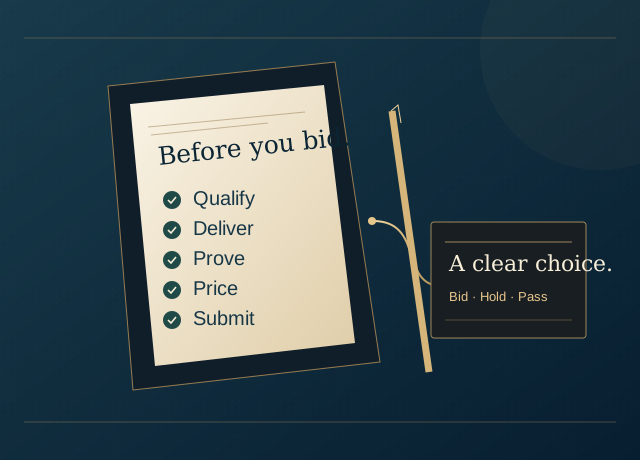
A clear choice, before you write.
Before writing a federal proposal, check five things: whether you qualify, can deliver the work, can provide the evidence the buyer asks for, can build a workable price, and can submit a complete response on time. Use the current solicitation and amendments. Resolve missing information before committing to the bid. A good fit is a reason to look closer, not a prediction that you will win.
In this guide
A contract can match your trade and still be a poor use of your time. Before drafting, answer five questions. Start with the full solicitation, its attachments and the latest amendments. A listing summary is not enough.
This checklist is GovVictory's practical planning method. It does not replace the solicitation or agency-specific rules and deviations. The FAR references below explain relevant principles; the instructions for your actual opportunity control your response.
1. Do you qualify?
Check the set-aside, size and status requirements, registrations, certifications and any contract vehicle restrictions that apply. Record where each requirement appears. Matching a NAICS code alone does not establish eligibility.
Write down: the eligibility requirement, your evidence and anything still to confirm.
If you need help understanding where to start, the SBA contracting guide offers public resources. For GovVictory's approach, see how we review an opportunity.
2. Can you do the work on the required dates?
Read the scope, location, start date, schedule and staffing needs. Confirm your people, equipment, partners and available capacity. Being able to do the work is different from being available when the buyer needs it.
FAR 9.104-1 covers contractor responsibility, including resources, delivery schedules, organization, experience and equipment. Use those topics as prompts for your own readiness check.
Write down: who will do the work, when they are available and any gap you must resolve.
3. Can you show the evidence the buyer asks for?
Read the evaluation criteria beside the response instructions. Match each requested item to evidence you can provide. If the buyer asks for a particular kind of experience, check the wording before assuming a similar job will count. Do not invent experience, credentials or results to fill a gap.
In negotiated acquisitions using the uniform contract format, Section L contains response instructions and Section M contains evaluation factors. Other formats organize them differently. See FAR 15.204-5 and FAR 15.304.
Write down: the requirement, the evidence you will use and its source.
4. Can you build a workable price?
List the costs needed to perform the scope. These may include labor, materials, equipment, subcontractors, travel, insurance and other solicitation requirements. Account for overhead and your intended margin. Record uncertain costs and how you will check them.
For covered construction, check the applicable wage and fringe requirements before pricing labor. Our wage determination guide explains that step with a clearly labeled example.
Contract value alone does not tell you what could remain after costs. Avoid treating the advertised amount as profit or guaranteed revenue.
Write down: your main cost assumptions, missing quotes and who will confirm the price.
5. Can you finish and submit correctly?
Confirm the question deadline, any required site visit, response deadline, time zone, submission method and required documents. Work backward from the due date. Leave time to review facts, price and attachments.
Ask unresolved questions through the channel the solicitation provides. Check for amendments again before submission and follow any acknowledgment instructions.
Write down: who prepares, reviews, approves and submits the response, with dates for each step.
Decide: Bid, Hold or Pass
Use a decision you can explain:
- Bid: the required items can be met, and the work fits your capacity and business goals.
- Hold: an important question can still be answered before the relevant deadline. Assign an owner and date.
- Pass: a required item cannot be met, the work does not fit, or the effort is not worthwhile for your business.
These are practical review labels, not a government scoring system. They do not estimate your chance of winning.
An illustrative example
A fictional cleaning company finds an opportunity nearby. It can perform the work and has relevant references. But the required start date falls while its crew is committed elsewhere. It cannot arrange a suitable team in time, so it passes.
The work matched the company's trade. The dates did not match its capacity. That is a useful reason to stop before writing a proposal.
Copy this decision note
Keep a short record that you can revisit when the requirements or your capacity change. This template is free to use and does not require a sign-up.
| Item | Your note |
|---|---|
| Opportunity | Title, solicitation number and link |
| Current version | Amendment number and date checked |
| Eligibility | Requirement and your evidence |
| Delivery | People, equipment, partners and available dates |
| Proposal evidence | Requested items and supporting records |
| Price | Main assumptions and costs still to confirm |
| Submission | Deadline, time zone, method and owner |
| Missing information | Question, owner and resolution date |
| Decision | Bid, Hold or Pass, with a short reason |
If you decide to bid, the next task is to turn the requirements into a complete response. See what proposal preparation involves, including the facts, costs and approvals the client supplies.
Questions people ask
Does matching the NAICS code mean I should bid?
No. It is a starting point. Check the solicitation's eligibility rules, scope, location, schedule, evaluation criteria and submission instructions against your business.
What should I do when an important detail is missing?
Write down the question, who will resolve it and the deadline. Use the question channel in the solicitation. Hold the decision while an answer is still possible; pass if a required item cannot be met.
Does this checklist estimate my chance of winning?
No. It helps you assess fit and readiness. Bid, Hold and Pass are GovVictory's practical review labels, not a government scoring system or a win probability.
Sources you can check.
These sources support the factual guidance. Checklists and examples are our editorial guidance. Regulations change. Each link shows when we last read it.
- FAR 9.104-1, General standards of contractor responsibilityReviewed 2026-10-14
- FAR 15.204-5, Proposal instructions and evaluation factorsReviewed 2026-10-14
- FAR 15.304, Evaluation factors and significant subfactorsReviewed 2026-10-14
- U.S. Small Business Administration, How to win contractsReviewed 2026-10-14